

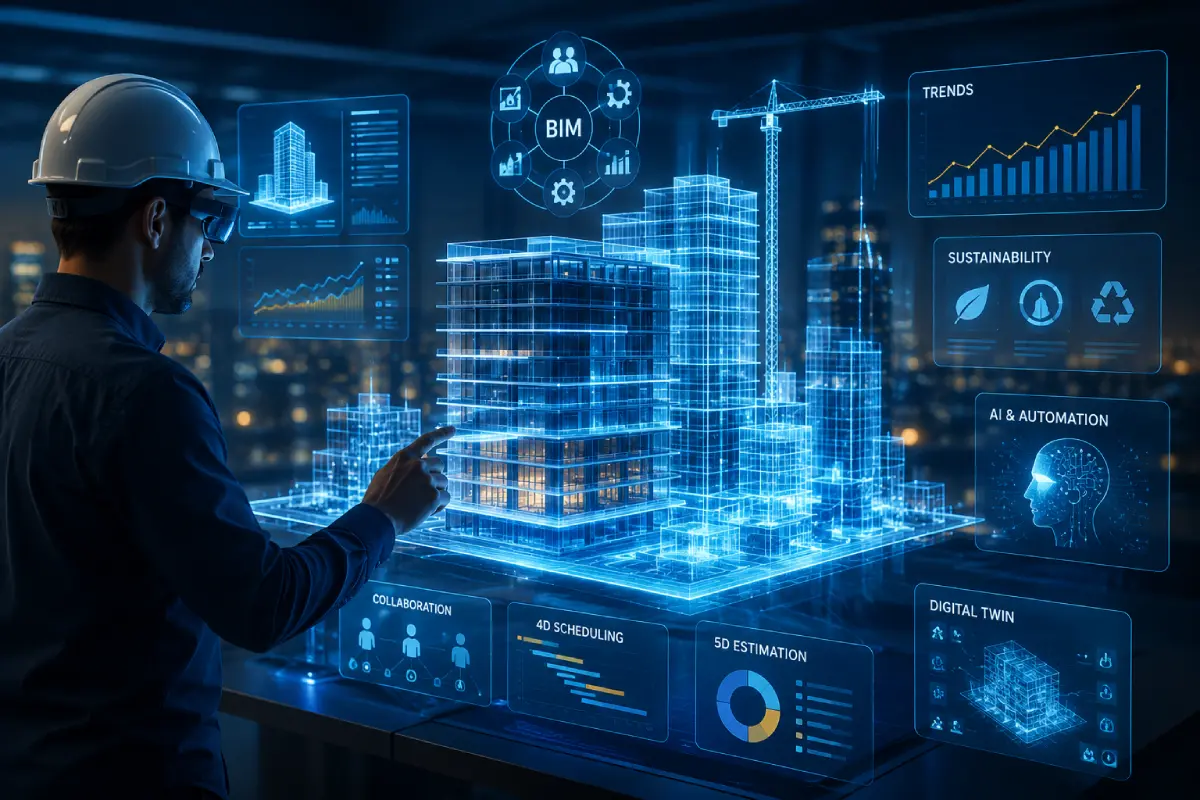
The AEC industry rapidly evolves, and BIM is at the core of the change. Teams today desire improved speed, more transparent data, and smarter decisions concerning projects. Due to that, companies are observing the largest BIM trends of 2026. BIM is already capable of the entire asset lifecycle, including planning and operations. Therefore, modeling is not the only thing to consider in 2026. Rather, it is the related workflows, enhanced understanding, and enhanced project results.
1. AI-Powered Workflows Are Becoming More Practical
The development of AI in BIM is one of the strongest tendencies. By 2026, AI will assist teams in analyzing design and construction data, identifying risks earlier on, and discovering alternatives to projects more quickly. It may also facilitate quality checks, better planning, and automate some of the inspection and review activities. So BIM is shifting the focus towards intelligent decision support as opposed to the previous static modeling. This elevates project teams and makes them quicker, more learned, and more assured.
AI also assists companies in smartly applying previous project data. As an illustration, teams are able to compare past jobs, review patterns, and make more powerful decisions before issues escalate. Nevertheless, AI is most efficient when the data of the projects is clean and organized. Thus, AI-led workflows will have the greatest benefit on firms that already have a good use of BIM.
2. Digital Twins Are Moving Into Daily Project Use
The other significant trend is the expansion of digital twins in AEC. A digital twin is a digital model of reality that makes links between building models, asset data, and frequently sensor or IoT inputs. Since it can be updated with live or connected data, it assists the teams in making better decisions in the design, delivery, and operation stages. This trend is increasingly helpful in 2026 since this is what the owners desire, not just improved design files but also better building performance working over time.
Digital twins have the potential to minimize risk, enhance performance, decrease expenses, and aid in the enhancement of lifecycle management. Therefore, they are not a mere idea of the future anymore. Rather, they are emerging as a sensible offshoot of BIM. Digital twins will continue to expand throughout homes, infrastructure, and smart city initiatives as additional owners seek smarter assets.
3. Open Standards Will Drive Better Collaboration
OpenBIM interoperability will also be advocated in 2026 by project teams. This is important since AEC projects are associated with lots of people, lots of tools, and lots of data formats. Without the ability of the systems to communicate effectively, teams waste time and make mistakes. According to buildingSMART, openBIM helps to facilitate the sharing of data, workflow flexibility, and trust in collaboration between platforms and stakeholders. Open workflows are thus emerging as a business requirement, and not a technical option.
This tendency is particularly significant for large and complicated projects. Working with various tools, open standards assist the architects, engineers, contractors, and the owners in maintaining information that can be used throughout the entire project lifecycle. They also facilitate machine-readable processes that can enhance automation and decision-making. Therefore, more robust interoperability will continue to influence the future development of BIM in the AEC sector.
4. Sustainability Will Be Built Into BIM Workflows
Sustainability is emerging as a BIM priority as well. Indeed, industry coverage has been maintained to bridge the gap between AEC innovation and sustainability, resilience, and enhanced asset performance. This is why sustainable BIM in construction is one of the most significant topics in 2026. BIM assists the team in researching materials, energy options, site performance, and long-term operations during an earlier period in the project process.
Consequently, sustainability decisions are able to occur earlier and with more information.
It is important as the owners and developers have raised their expectations of buildings and infrastructure. They desire reduced wastage, smarter maintenance, and improved performance in the long run. Thus, BIM is becoming more associated with environmental analysis, lifecycle thinking, and resilient asset management. Sustainable delivery will not be on the periphery of BIM in 2026. Rather, it will form part of the daily BIM plan.
5. BIM Will Support the Full Asset Lifecycle
The last trend is lifecycle thinking. BIM is also applied in operation, maintenance, and asset performance in addition to the design and construction. It implies that project teams are creating information models that remain helpful post-handover. Such a change benefits owners seeking superior information even after the building is finished. Thus, 2026 BIM success will not rely on it being a short-term delivery but on long-term value.
Conclusion
The BIM of the future in AEC is more viable, more integrated, and more strategic. By 2026, the most significant improvements will be in the use of better data, great collaboration, and smart project decisions. The AI will assist in analysis, digital twins will enhance activities, and open standards will maintain the consistency of the teams. Concurrently, sustainability and lifecycle value will influence the measurement of success by firms. Thus, early adopters will be in a better position to deal with the next phase of digital building.